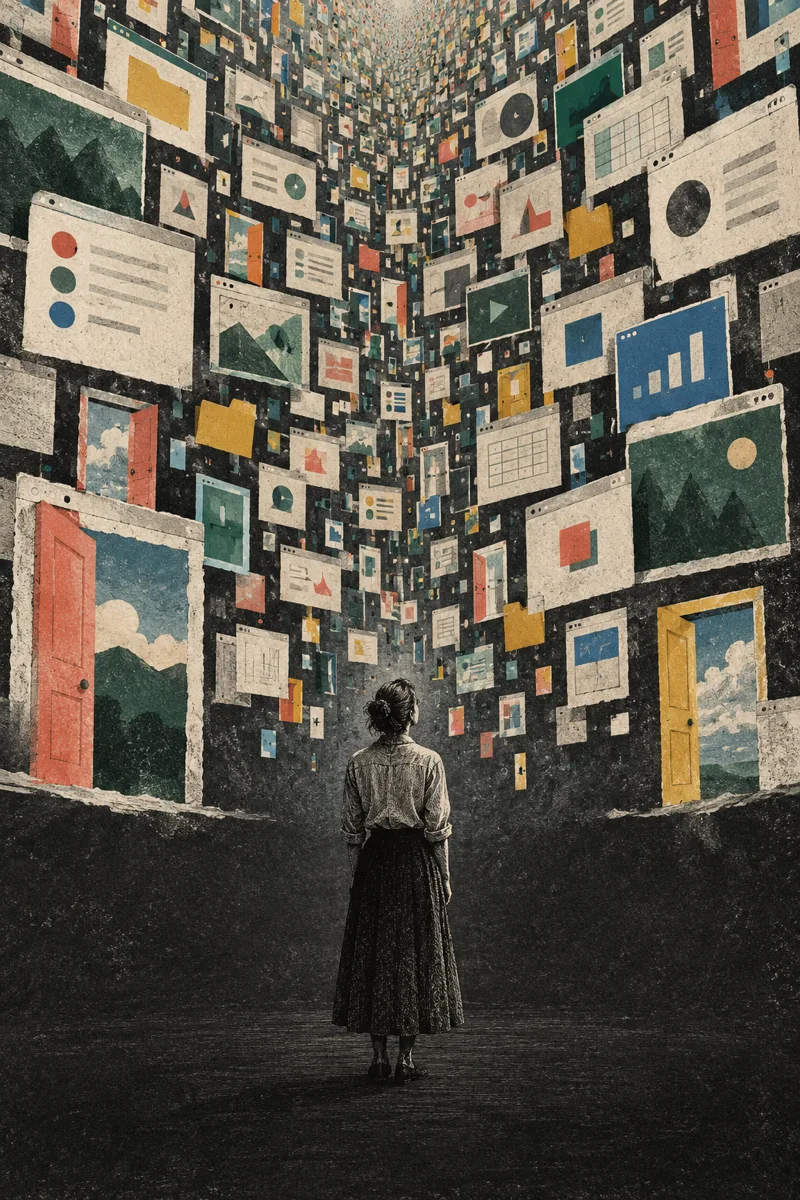
Software Is Multiplying. Users Aren’t.
AI can automate nearly everything between an idea and a working product. But today, it is not your paying customer.
Something strange has started happening when I build software.
I can have an idea, open Claude, and produce a working version in an hour. If I do not like it, I can produce five more.
Then, occasionally, I never meaningfully use any of them.
A few years ago, building something required enough time that I had to sit with the idea. I thought about the problem, refined the experience, and imagined myself using it long before it existed.
Now the software can arrive before the conviction does.
That is an incredible capability.
It also reveals a bottleneck we have mostly avoided talking about.
The new bottleneckSOFTWARE×∞USERS×1
We automated the loop, but not the user.
The conversation about AI and software development has progressively moved through the software development lifecycle.
First, it was about generating code.
Then it became about generating better code. Reviewing it. Testing it. Deciding what to build in the first place.
An agent can increasingly research a problem, write the code, review its own work, launch an iOS simulator, navigate through the product, find a broken flow, fix it, and confirm that everything works.
That is an extraordinary amount of the loop to automate.
But the simulator is not your customer.
A real person still has to discover the product. They have to choose it over every alternative available to them. They have to use it in the strange, unpredictable way that humans use things. They have to receive enough value to return and, in many cases, decide it is worth paying for.
At the end of the automated SDLC, the software may be complete.
The product loop has barely begun.
Your agent can prove that the product works. It cannot prove that a paying customer wants it.
Consumers are becoming makers.
Historically, software had a relatively small group of makers serving a much larger group of consumers.
AI is changing that ratio.
More people can now build exactly what they want, for whatever strange and specific use case they have.
Initially, that does not necessarily mean fewer consumers. More makers can create new products, new categories, and new reasons to use software. The overall market can continue growing.
But play it forward a few years.
If I can describe a small tool and have it built for me immediately, I may no longer need to find, evaluate, buy, and adopt someone else’s version of it.
Sometimes I may not need another product at all.
Recently, I asked Emma, my personal chief-of-staff agent, to find restaurants that matched what I wanted, check availability for specific dates, give me a few options, and make the reservation.
I did not open Google Maps, Resy, or OpenTable. I did not compare tabs or navigate their booking flows.
Those systems may still have participated underneath. But I was no longer meaningfully their user.
Emma became the interface. The products behind her became infrastructure.
A product can retain usage while losing its relationship with the user.
That distinction matters.
The number of humans is not multiplying alongside the amount of software. Neither are their budgets, workflows, or willingness to adopt new products.
Some products will continue to own a direct relationship with people. Some will become tools used by agents. Some categories will consolidate into a handful of interfaces. Some software will simply be generated when it is needed and discarded afterward.
Software supply is expanding rapidly.
The number of paying customers is not expanding at the same rate.
Few people build.
Most people buy.
More people build.
Consumption grows too.
People increasingly build
what they once bought.
A working product is not a used product.
This does not mean human-facing software is going away.
It means producing working software is becoming weaker evidence that you have found something worth building.
You can ask a model to invent personas, synthesize research, predict objections, and simulate how someone might move through your product.
You can give an agent a phone simulator and watch it complete every flow perfectly.
You can generate the landing page, run outbound, create ads, personalize the pitch, and optimize the funnel.
All of that is valuable.
But humans remain wonderfully inconvenient.
They misunderstand things. They ignore features. They invent workflows you never anticipated. They care about details your research said were irrelevant and overlook the ones you considered essential.
That is what makes building for them fun.
It is also why getting your product in front of them cannot be treated as something that happens after product development.
It is product development.
Do not simulate the answer foreverDon’t figure it out.
Go find out.
We can spend increasingly large amounts of compute trying to predict what people will do.
Or we can put something in front of them and observe what they actually do.
Some questions can be reasoned through with models.
Others require contact with reality.
AI can build the product. It can test every flow. It can market the product and bring customers to the door.
But today, AI is not your paying customer.
Somewhere at the end of the loop, a human, or an organization acting for humans, still has to decide that what you built is worth using and paying for.
You cannot replace that decision with another simulation.
Don’t figure it out.
Go find out.
What are you trying to find out?
If you are building something that needs contact with real users, I’d like to compare notes.
Start a conversation →